Setting the scene
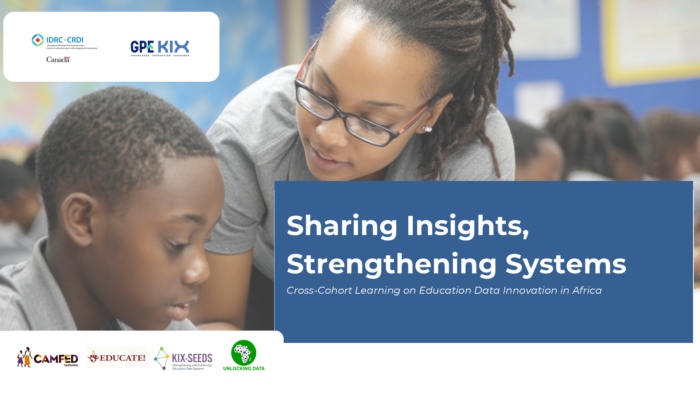
Africa’s education systems are undergoing a quiet transformation, one driven by stronger data pipelines, growing cultures of evidence use, and deeper collaboration across countries. This was the focus of our recent regional learning exchange, Sharing Insights, Strengthening Systems: Cross-Cohort Learning on Education Data Innovation in Africa.
Bringing together policymakers, academics, researchers, and implementing partners, the session highlighted a unified ambition: to move from data collection to meaningful data use, and from innovation to long-term institutionalisation.
Dr. Patrick Mbah Okwen from eBase Africa opened the webinar by reinforcing a central message: data becomes powerful only when it strengthens systems and empowers the people who use it. He underscored how ministries across the continent are beginning to ask sharper questions, build stronger data systems, and generate insights that matter for decision-making.
Patrick Walugembe of IDRC followed by connecting this work to the broader GPE KIX vision. He reminded participants that investments in dashboards, platforms, and assessments only achieve their full potential when they inform policy, classroom practice, and resource allocation.
With that, panelists from Cameroon, Rwanda, Uganda, Tanzania, and Kenya took participants into the heart of real-world implementation—showing what evidence-informed practice looks like across diverse contexts.
🗣️Key Speakers
- Dr. Patrick Mbah Okwen, eBase Africa and Unlocking Data Initiative
- Patrick Walugembe, International Development Research Centre (IDRC)
- Bauket George, Ministry of Basic Education (MINEDUB), Cameroon
- Dr. Bernard Bahati, Director General, National Examination and School Inspection Authority (NESA), Rwanda
- Monica Amuha, Team Lead, DHIS2 for Education, Health Information Systems Program, Uganda
- Robert Msigwa, Secondary Education Coordinator, PMO-RALG / Ministry of Education, Tanzania
- Prof. Hilda Omae, Deputy Vice Chancellor, Administration, Finance & Planning, Meru University, Kenya
- Dr. Nafisa Waziri, EdTech Hub
View the webinar here
🎯 Key Takeaways
Data use must be champion-led, not project-led
Across all countries, panelists emphasised that data systems succeed when policymakers value and demand data. Dr Bahati (Rwanda) noted that policy uptake depends on leaders who recognise the role of evidence in improving learning outcomes. Without this, even well-designed systems remain underutilised.
Capacity building is central to sustainability
From Cameroon’s classroom-level challenges to Uganda’s district-level gaps, the message was clear:
Data systems are only as strong as the people running them. Uganda is addressing this by deploying statisticians at the district level. Cameroon highlighted the need for continuous training to improve indicator literacy. Tanzania is training teachers, the primary data producers, to improve data entry and interpretation.
Interoperable, real-time systems unlock new possibilities
Rwanda’s Comprehensive Assessment Management Information System (CAMIS), built with Educate!, and Uganda’s repurposing of DHIS2 show how digital innovations can create real-time insights that improve early intervention for learners falling behind.
The panel stressed the need for systems that integrate administrative and learning data, link education and health data where relevant, and provide dashboards and school report cards for easy use.
Local ownership ensures long-term impact
A recurring theme was local ownership from ministries, schools, and subnational offices. Whether through Rwanda’s nationwide dashboard access, Tanzania’s push for unified government systems and Kenya’s embedding of evidence use in graduate training, panelists highlighted the importance of rooting innovations in national structures so they endure beyond project cycles.
Evidence must be packaged for decision-makers
Prof. Omae emphasised that numbers alone do not drive change—stories around the numbers do. To influence practice, evidence must be simple, visual, actionable, and contextualised. These are essential to bridge the gap between data generation and policy shifts.
🙋🏽♀️ Questions from the session—Answered Live
These questions have been edited for correct grammar and flow. Responses to these questions have been captured through our Webinar recording, which you can listen to here.
- Thanks, colleagues from Cameroon and Uganda. My worry is to know how follow-up is done on the data dissemination done ie daily, weekly, monthly, etc. Which mechanism has been put in place to ensure that the recommendations are implemented?
- Some countries, particularly sub-Saharan African countries and those ravaged by war, conflicts and terrorists, don’t have a budget to collect, clean, and analyse accurate and more secure quality data to support the decision-making process. What kind of support do those countries get?
- I appreciate insights on data generation, collection, analysis, use of evidence and sharing with policy makers. How best do we improve the packaging and communication of the evidence to the policy makers?
- In one way, we may have a lot of research findings, but what can we do to make sure that these available data are used to inform classroom practices, police makers at all levels? And how can we reduce this fragmented situation?
- Thank you so much for the wonderful education. My worry is how to recognise correct data for decision-making because the internet always provides us with several data. How do we identify the correct one
🙋🏽♀️ Questions from the session—Answered Via Q&A
In this section, we provide questions and answers to questions that panellists responded to in writing via the Q&A function. Please note that these questions have been edited for correct grammar and flow.
❓Question: Challenges in Ethiopia are issues of data quality, and supporting the government and policy makers to use the data. Similarly, how is the frequency of the assessment conducted?
📝 Answer: In Kenya, we have a similar problem. On quality, we have to build the capacity of the data officers by equipping them with skills and sometimes software. Put them in workshops on basic data quality classes and analysis using basic data software such as Excel. Collaborating with a university is a big win. Evidence-use culture is a challenge, too, and one way to handle it is co-creation with the government. For instance, ask them the data-related problem that bothers them and co-develop a solution with their own data. You must be watchful that the government is very protective of the same data they are not using
❓Question: I am planning to meet up with key people in education in Africa to explore how we can collect, analyse and strategise on how African countries feed into the Sustainable Development Goal 4 on Quality Education. I would be happy to collaborate with anyone interested.
Note: If you would like to collaborate on SDG4, please let us know, and we shall connect you to this contact.
📝 Answer: Reporting on the SDG4 indicators has been a challenge for most countries. On the DHIS2-Ed project, we have designed standard datasets for the SDG4 indicators and are currently supporting countries to align their primary data sources to collect and report on this data.
❓Question: Great to hear you have started to transition into DHIS2. Are you only using health data or data on educational outcomes? In DHIS2, do you only use it for data entry or for analysis and visualisation, like Dashboards, charts, Pivot tables, GIS maps, etc?
📝 Answer: Yes, we are collecting education data using DHIS2, which informs health programs in schools. We capture data in DHIS2 but also use the system to analyse and present this data on dashboards that are accessible at the national, district and school levels
❓Question: Again, about DHIS2 usage, are you people using it only at the level of delegation, ministry or school level
📝 Answer: DHIS2 is web-based and can be accessed across all levels from the school, district, up to the ministry level. So, data captured at the school level is available to users across the education level
❓Question: Is there a possibility of using mobile apps like https://dimagi.com/ to enable teachers and school actors to collect and report data?
📝 Answer: Yes, this is a possibility with different innovations. Mobile first and offline capabilities are very critical, especially for schools that have limited resources and poor internet connectivity, and also in areas with insurgencies like Mr Bauket talked about. For example, with DHIS2-Ed we are able to collect data using Android phones, and this can also be collected offline and uploaded into the system when there is internet connection.
❓Question: But how do we make sure that the data collected, analysed, and the policies developed benefit the very same learners/students that the data belong to? We have had problems where the data collected today, the policies developed from such evidence, will be used after five or more years.
📝 Answer: Part of this is due to capacity—we have many data collectors; however, we may not have enough with the skill/ equipment/software to analyse the data and translate it into useful information on time. This is all the more reason why we all need to know how to interpret data—even at a minimal level.
❓Question: Is there a formal process that allows innovators to access real education data for solution development, and what safeguards or approvals are required to stay within data protection laws?
📝 Answer: Very important question. One thing we found in Kenya, Malawi and Cameroon, which is actually the story across Africa, is the closed data culture. This is one of the elephants in the room
❓Question: How can we address significant cultural barriers affecting us from not using data rather than simply reporting it?
📝 Answer: First is helping the government solve their problems with their own data. We have also realised there is a wrong assumption that the data holders know how to use data. There is a capacity gap in how to use that data.
❓Question: Among qualitative and quantitative data, which should be more accurate and relevant than others?
📝 Answer: I think it depends on the context, really. You can’t say one is better than the other
Resources
- Learn more about CAMFED’s work: https://camfed.org/publications/
- Explore a collection of Resources about Educate!’s Work and Impact to Date: https://www.experienceeducate.org/resource-library
- Knowledge Innovation Exchange-Strengthening and Enhancing Education Data Systems (KIX-SEEDS)