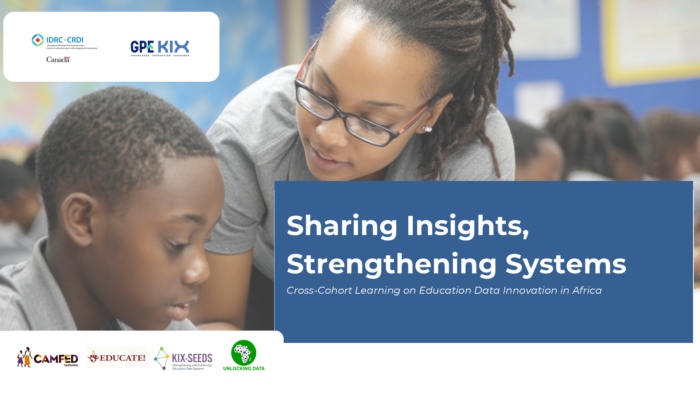
Sharing Insights, Strengthening Systems: Cross-Cohort Learning on Education Data Innovation in Africa

Setting the scene

Africa’s education systems are undergoing a quiet transformation, one driven by stronger data pipelines, growing cultures of evidence use, and deeper collaboration across countries. This was the focus of our recent regional learning exchange, Sharing Insights, Strengthening Systems: Cross-Cohort Learning on Education Data Innovation in Africa.

Bringing together policymakers, academics, researchers, and implementing partners, the session highlighted a unified ambition: to move from data collection to meaningful data use, and from innovation to long-term institutionalisation.

Dr. Patrick Mbah Okwen from eBase Africa opened the webinar by reinforcing a central message: data becomes powerful only when it strengthens systems and empowers the people who use it. He underscored how ministries across the continent are beginning to ask sharper questions, build stronger data systems, and generate insights that matter for decision-making.

Patrick Walugembe of IDRC followed by connecting this work to the broader GPE KIX vision. He reminded participants that investments in dashboards, platforms, and assessments only achieve their full potential when they inform policy, classroom practice, and resource allocation.

With that, panelists from Cameroon, Rwanda, Uganda, Tanzania, and Kenya took participants into the heart of real-world implementation—showing what evidence-informed practice looks like across diverse contexts.

🗣️Key Speakers

  • Dr. Patrick Mbah Okwen, eBase Africa and Unlocking Data Initiative
  • Patrick Walugembe, International Development Research Centre (IDRC)
  • Bauket George, Ministry of Basic Education (MINEDUB), Cameroon
  • Dr. Bernard Bahati, Director General, National Examination and School Inspection Authority (NESA), Rwanda
  • Monica Amuha, Team Lead, DHIS2 for Education, Health Information Systems Program, Uganda
  • Robert Msigwa, Secondary Education Coordinator, PMO-RALG / Ministry of Education, Tanzania
  • Prof. Hilda Omae, Deputy Vice Chancellor, Administration, Finance & Planning, Meru University, Kenya
  • Dr. Nafisa Waziri, EdTech Hub

View the webinar here

🎯 Key Takeaways

Data use must be champion-led, not project-led

Across all countries, panelists emphasised that data systems succeed when policymakers value and demand data. Dr Bahati (Rwanda) noted that policy uptake depends on leaders who recognise the role of evidence in improving learning outcomes. Without this, even well-designed systems remain underutilised.

Capacity building is central to sustainability

From Cameroon’s classroom-level challenges to Uganda’s district-level gaps, the message was clear:
Data systems are only as strong as the people running them. Uganda is addressing this by deploying statisticians at the district level. Cameroon highlighted the need for continuous training to improve indicator literacy. Tanzania is training teachers, the primary data producers, to improve data entry and interpretation.

Interoperable, real-time systems unlock new possibilities

Rwanda’s Comprehensive Assessment Management Information System (CAMIS), built with Educate!, and Uganda’s repurposing of DHIS2 show how digital innovations can create real-time insights that improve early intervention for learners falling behind.

The panel stressed the need for systems that integrate administrative and learning data, link education and health data where relevant, and provide dashboards and school report cards for easy use.

Local ownership ensures long-term impact

A recurring theme was local ownership from ministries, schools, and subnational offices. Whether through Rwanda’s nationwide dashboard access, Tanzania’s push for unified government systems and Kenya’s embedding of evidence use in graduate training, panelists highlighted the importance of rooting innovations in national structures so they endure beyond project cycles.

Evidence must be packaged for decision-makers

Prof. Omae emphasised that numbers alone do not drive change—stories around the numbers do. To influence practice, evidence must be simple, visual, actionable, and contextualised. These are essential to bridge the gap between data generation and policy shifts.

🙋🏽‍♀️ Questions from the session—Answered Live

These questions have been edited for correct grammar and flow. Responses to these questions have been captured through our Webinar recording, which you can listen to here. 

  1. Thanks, colleagues from Cameroon and Uganda. My worry is to know how follow-up is done on the data dissemination done ie daily, weekly, monthly, etc. Which mechanism has been put in place to ensure that the recommendations are implemented?
  2. Some countries,  particularly sub-Saharan African countries and those ravaged by war, conflicts and terrorists, don’t have a budget to collect, clean, and analyse accurate and more secure quality data to support the decision-making process. What kind of support do those countries get?
  3. I appreciate insights on data generation, collection, analysis, use of evidence and sharing with policy makers. How best do we improve the packaging and communication of the evidence to the policy makers?
  4. In one way, we may have a lot of research findings, but what can we do to make sure that these available data are used to inform classroom practices, police makers at all levels? And how can we reduce this fragmented situation?
  5. Thank you so much for the wonderful education. My worry is how to recognise correct data for decision-making because the internet always provides us with several data. How do we identify the correct one

🙋🏽‍♀️ Questions from the session—Answered Via Q&A

In this section, we provide questions and answers to questions that panellists responded to in writing via the Q&A function. Please note that these questions have been edited for correct grammar and flow.

Question: Challenges in Ethiopia are issues of data quality, and supporting the government and policy makers to use the data. Similarly, how is the frequency of the assessment conducted?

📝 Answer: In Kenya, we have a similar problem. On quality, we have to build the capacity of the data officers by equipping them with skills and sometimes software. Put them in workshops on basic data quality classes and analysis using basic data software such as Excel. Collaborating with a university is a big win. Evidence-use culture is a challenge, too, and one way to handle it is co-creation with the government. For instance, ask them the data-related problem that bothers them and co-develop a solution with their own data. You must be watchful that the government is very protective of the same data they are not using

Question: I am planning to meet up with key people in education in Africa to explore how we can collect, analyse and strategise on how African countries feed into the Sustainable Development Goal 4 on Quality Education. I would be happy to collaborate with anyone interested. 

Note: If you would like to collaborate on SDG4, please let us know, and we shall connect you to this contact. 

📝 Answer: Reporting on the SDG4 indicators has been a challenge for most countries. On the DHIS2-Ed project, we have designed standard datasets for the SDG4 indicators and are currently supporting countries to align their primary data sources to collect and report on this data.

Question: Great to hear you have started to transition into DHIS2. Are you only using health data or data on educational outcomes? In DHIS2, do you only use it for data entry or for analysis and visualisation, like Dashboards, charts, Pivot tables, GIS maps, etc?

📝 Answer: Yes, we are collecting education data using DHIS2, which informs health programs in schools. We capture data in DHIS2 but also use the system to analyse and present this data on dashboards that are accessible at the national, district and school levels

Question: Again, about DHIS2 usage, are you people using it only at the level of delegation, ministry or school level

📝 Answer: DHIS2 is web-based and can be accessed across all levels from the school, district, up to the ministry level. So, data captured at the school level is available to users across the education level

Question: Is there a possibility of using mobile apps like https://dimagi.com/ to enable teachers and school actors to collect and report data?

📝 Answer: Yes, this is a possibility with different innovations. Mobile first and offline capabilities are very critical, especially for schools that have limited resources and poor internet connectivity, and also in areas with insurgencies like Mr Bauket talked about. For example, with DHIS2-Ed we are able to collect data using Android phones, and this can also be collected offline and uploaded into the system when there is internet connection. 

Question: But how do we make sure that the data collected, analysed, and the policies developed benefit the very same learners/students that the data belong to? We have had problems where the data collected today, the policies developed from such evidence, will be used after five or more years.

📝 Answer: Part of this is due to capacity—we have many data collectors; however, we may not have enough with the skill/ equipment/software to analyse the data and translate it into useful information on time. This is all the more reason why we all need to know how to interpret data—even at a minimal level.

Question: Is there a formal process that allows innovators to access real education data for solution development, and what safeguards or approvals are required to stay within data protection laws?

📝 Answer: Very important question. One thing we found in Kenya, Malawi and Cameroon, which is actually the story across Africa, is the closed data culture. This is one of the elephants in the room

Question: How can we address significant cultural barriers affecting us from not using data rather than simply reporting it?

📝 Answer: First is helping the government solve their problems with their own data. We have also realised there is a wrong assumption that the data holders know how to use data. There is a capacity gap in how to use that data.

Question: Among qualitative and quantitative data, which should be more accurate and relevant than others?

📝 Answer: I think it depends on the context, really. You can’t say one is better than the other

Resources

Bridging the Data-Evidence Gap in Education for Improving Foundational Learning in Malawi

By Paul Chiwaya, Louiss Saddick, Halima Twabi, and Esme Kadzamira

Invisible evidence and inaccessible data undermining the progress of foundational learning in Malawi. What will it take to make evidence visible and data accessible?

Introduction

In this blog, we explore gaps in evidence availability and data accessibility that hinder informed decision-making on foundational learning in Malawi, and discuss the key actions needed to make evidence visible and data accessible. We conducted a country situational analysis to map data and evidence on foundational learning since 2010. The findings reveal that despite increasing recognition of the importance of foundational skills such as literacy, numeracy, and socio-emotional competencies, progress is held back by high internal inefficiencies, poor learning outcomes, and an underutilised evidence base that remains sparse, fragmented, and often inaccessible (⇡Kadzamira et al., 2025; ⇡Asim & Gera, 2024).

The state of Foundational Learning in Malawi

Malawi’s education system has long struggled with chronic resource constraints, inadequate infrastructure, high repetition rates, and high pupil-teacher ratios—factors that continue to undermine the delivery of quality foundational education. These systemic challenges have made it difficult to ensure that all children acquire basic literacy and numeracy skills. Despite concerted efforts by the government and development partners, learning outcomes at the foundational level remain alarmingly low.

National assessments conducted since the early 2000s, such as the Early Grade Reading Assessment (EGRA) and Early Grade Mathematics Assessment (EGMA), reveal that a significant proportion of Malawian learners in the early grades are not meeting the expected benchmarks for reading and numeracy (⇡Pouezevara et al., 2012; ⇡Brombacher, 2019). These challenges are particularly acute in rural areas, where shortages of qualified teachers and adequate learning materials are most severe (⇡Asim & Gera, 2024). 

To help turn the tide, international organisations like Save the Children, USAID, and the World Bank have stepped in with programs to boost foundational learning in Malawi. These programs have introduced early literacy and numeracy interventions, teacher training, and community engagement initiatives. But there’s a catch—without reliable data to track progress, it’s difficult to determine their effectiveness, identify what works and what doesn’t, and sustainability build on any gains made.

Data gaps and inaccessibility: A major barrier to progress

A significant obstacle to improving foundational learning in Malawi is the lack of accessible and reliable data. Accurate data collection is crucial for understanding the state of learning in the country, identifying improvement areas, and measuring the effectiveness. One of the key issues is the sheer inaccessibility of data. Much of the data on foundational learning is collected through large-scale assessments, national surveys, and international evaluations. Yet, this information is not always publicly available or easily accessible to stakeholders who need it most. While government ministries, international organisations, and research institutions may collect valuable data, the lack of a centralised database or platform to share and access this data presents a major barrier to progress.

Data is often siloed, either within government agencies or within the organisations that commissioned the studies. These restrictions limit collaboration and hinder the use of data to inform national policies and programming. Without clear, open, and transparent data systems, stakeholders such as educators, policymakers, and civil society organisations struggle to make data-driven decisions to improve foundational learning.

Furthermore, limited access to education data in Malawi hinders efforts to identify gaps and inconsistencies in the data system, making it difficult to gain a clear understanding of the challenges learners face in acquiring foundational skills. For instance, while assessments like EGRA and EGMA provide some insight into literacy and numeracy learning outcomes, far less information is available about socio-emotional learning. Data on the learning environment, including teacher-student interactions, the quality of instructional materials, and the role of parental involvement, is also scarce. This incomplete picture means that interventions may only address a portion of the problem, inadvertently leaving critical areas overlooked.

The invisibility of evidence: A hindrance to effective policy

The problem of invisible evidence is closely tied to the issue of data gaps. Even when data is collected, it is often not synthesised into actionable evidence that can inform policy, programs, and decision-making. As a result, foundational learning interventions in Malawi are sometimes based on assumptions rather than robust evidence, reducing their overall effectiveness.

Another aspect of this challenge is the limited analysis of students’ progress over time. Although our mapping exercise revealed the existence of longitudinal datasets that can be used to analyse students’ progress over time, these datasets have not been analysed. As a result, it is difficult to determine whether interventions aimed at improving foundational learning have sustained effects on learners’ outcomes. Furthermore, limited research exists on the specific needs of different regions, such as rural versus urban areas, which can result in one-size-fits-all solutions that may not address the unique challenges faced by various communities.

Addressing the gaps: Steps toward improvement

While the challenges related to data and evidence are significant, they are not insurmountable. Several key actions can be taken to address these issues and increase the use and users of foundational learning data in Malawi:

  • Strengthening data systems through co-creation of a centralised data portal: One critical step is strengthening Malawi’s education data systems. This should involve creating a centralised platform where data from different sources—government assessments, donor programs, and independent studies—can be housed and accessed by all stakeholders. Such a platform should prioritise openness, accessibility, and transparency, allowing for real-time data sharing and breaking down existing data silos.
  • Improving data collection: There is a vital need to improve the quality and scope of data collection efforts. Beyond literacy and numeracy, data should also capture socio-emotional skills, teacher quality, classroom environments, and parental involvement. To ensure inclusivity and relevance for targeted interventions, data must be disaggregated by region, gender, socioeconomic status, and disability. Furthermore, regular feedback sessions are essential for identifying gaps in data collection methods and tools and for continuously improving data systems. 
  • Transforming data into actionable evidence: Collecting data is only the first step. Malawi must invest in systems and processes that transform raw data into actionable evidence. This includes establishing well-resourced national and sub-national data analysis units capable of synthesising complex datasets into clear, evidence-based policy recommendations. At the sub-national level, tools like dashboards enable rapid data visualisation and support timely, informed decision-making. These tools also play a critical role in identifying data gaps and improving data collection methods and tools.
  • Engaging stakeholders: Addressing the foundational learning crisis requires a collective effort from all stakeholders involved in the education sector. This includes the Ministry of Education, development partners, civil society organisations, and local communities. Regular stakeholder engagement will ensure that on-the-ground realities inform interventions and address the unique needs of different regions and groups, moving away from potentially ineffective one-size-fits-all approaches.
  • Fostering a culture of transparency and accountability: Finally, there needs to be a greater emphasis on transparency and accountability on data within the education sector. This can be done by, among other things, revising data-sharing policies to allow ethical sharing and access to important education data and creating agreements between the Ministry of Education and stakeholders to support evidence-based planning. By making data and evidence publicly available, the government can foster a culture of transparency and accountability. This, in turn, will encourage education stakeholders to utilise data-driven approaches in designing, implementing, and evaluating foundational learning programs, ultimately leading to more effective and sustainable outcomes.

The promise of foundational learning in Malawi cannot be realised without addressing the critical gaps in data and evidence. Strengthening data systems, improving the accessibility of information, and turning data into actionable evidence are essential to building an education system that provides every Malawian child with the skills they need to succeed in life. By confronting these challenges head-on, Malawi can ensure its foundational learning programs are effective, equitable, and sustainable, laying the groundwork for a brighter future for all. 

References

  • Brombacher, A. (2019). Research to Investigate Low Learning Achievement in Early Grade Numeracy (Standards 1–4) in Malawi: The victory of form over substance. HEART. https://docs.edtechhub.org/lib/AIUSUUNA
  • Kadzamira, E., Saddick, L., Twabi, H., & Chiwaya, P. (2025). Exploring the Foundational Learning Data and Knowledge Ecosystem in Sub-Saharan Africa: Malawi’s Situational Analysis. Unlocking Data. https://doi.org/10.53832/unlockingdata.1019

What it takes to move from education evidence to action

By Unlocking Data Initiative

This blog highlights key insights from a recent webinar that focused on foundational learning data from Cameroon, Kenya, and Malawi

Data and evidence are crucial in improving educational outcomes, including foundational learning. However, fragmented data ecosystems, limited accessibility to evidence and data, and mistrust between stakeholders continue to hinder its full potential. The Unlocking Data Initiative has been driving conversations to increase the use and users of data across sub-Saharan Africa. Since 2024, the initiative, funded by a GPE-KIX grant has been working in Cameroon, Kenya, and Malawi to map foundational learning data and implement collaborative research methods with data stakeholders to address bridge data gaps. In February, our webinar explored the state of foundational learning data in these countries, as published in 3 situational analysis reports for each of Kenya, Cameroon, and Malawi, as well as a cross-country report comparing challenges and lessons learnt. The webinar highlighted key challenges, opportunities, and practical ways to strengthen evidence use in foundational learning. Here are our key takeaways:

A critical first step: What do we know about the definitions of foundational learning in Unlocking Data focus countries?

As explained by Rigobert Pambe, Deputy Programme Lead at eBase, in Cameroon, foundational learning lacks a clear definition within policy and practice, making it difficult to align interventions across the region. While strong policies exist, implementation remains a challenge, particularly in conflict-prone areas. In Kenya, foundational learning focuses on improving learning outcomes for learners between the ages of 4 and 10.

The stakeholder landscape for foundational learning

Cameroon’s strong policies that drive foundational learning are embedded within the country’s education-governing institutions. Data from the country’s situational analysis reveal that the universities are not very involved in research on foundation learning. Most of the research outputs found focused on literacy and a little bit on teacher professional development. Areas like numeracy, social and emotional learning, and inclusive education were relatively neglected. 

In Kenya, the county government takes charge of early child development education (ECDE), while the national government delivers education services for primary 1 and upwards. This leads to fragmented efforts and inconsistent policies across the different levels of learning. 

In Malawi, foundational learning is managed across multiple ministries. The Ministry of Gender, Community Development, and Social Affairs is responsible for early childhood education, while the Ministry of Education focuses on basic and other levels of education, with little collaboration. This leads to gaps in data use and decision-making. 

Is fragmentation limiting data use and causing mistrust within the ecosystem?

Across all three countries, mistrust between government agencies, researchers, and policymakers limits the effective use of data. Governments often prefer to rely on their data, while researchers struggle to access official datasets. In Cameroon, research on foundational learning is limited, with universities largely disengaged. Much of the available data is published in English, limiting accessibility for francophone audiences, but also indicating limited opportunities for women to engage in data generation and publishing. A gendered analysis of publications also indicates limited female presence in the data generation space. In Kenya, researchers often reference data from the development sector or donor organisations such as the World Bank. In most cases, this data is easily accessed by development partners from the government because of a seemingly credible engagement between the government and the development sector. Meanwhile, in Malawi, researchers hold valuable insights on early childhood education, but much of their work remains siloed within universities, never making its way into classrooms where it’s needed most. This is mostly driven by researchers who fear the possibility of exposure of gaps in the data collection process and having their data plagiarized.

Gaps in foundational learning data

Across the countries of focus, research tends to focus heavily on literacy, with minimal attention to numeracy, social-emotional learning, inclusive education, and pre-primary readiness. Special needs education data remains scarce, making it difficult to design and implement inclusive policies. Data collected by governments is often outdated by the time it reaches decision-makers, as there is little integration with data collected by the respective ministries and departments, civil society organisations (CSOs) and universities.

What do we learn from what is working?

There are various opportunities to improve data use and data sharing. The Kenyan county governments are increasingly seeking support to package data into actionable reports, signalling a willingness to open data to the rest of the ecosystem and a shift towards evidence-based decision-making. In addition, a foundational learning community of practice has been formed to offer technical assistance on foundational learning policies and resource mobilization. Networks of organisations in Cameroon are coming together to share knowledge and set a common agenda for foundational learning, while in Malawi, new district-level data collection initiatives are piloting real-time dashboards, allowing for timely decision-making based on local needs.

How can the data ecosystem be strengthened across the three countries?

“The Kenyan universities, ministry directorates, and departments are now reaching out to co-create data collection tools, synthesize existing evidence, and in general strengthen the research functions. This is a good endorsement towards the long-term goal of evidence use in decision-making,” says Charles Gachoki, Research Manager, Evidence Synthesis and Translation, Zizi Afrique Foundation. To help strengthen this collaboration and put data into good use, creating champions and communities will encourage lateral learning for decision-making based on evidence.”

Building a central data repository will help in establishing a single open and accessible source of truth when it comes to connecting all data sources. Rigobert Pambe emphasises the need to establish a way to set up policies for data sharing, collection, and archiving. This unified, open-access platform for foundational learning data could streamline collaboration among stakeholders. While this could be a stronger solution, it needs an intentional and strategic investment in training and setting up digital systems that could help stakeholders collect, share, and analyze data more effectively.

There continues to be a call to create data sharing and archiving policies, in which clear regulations on data access, confidentiality, and use are put in place to build trust and increase data availability. There is an opportunity to learn from the other sector. For instance, in Malawi, the agricultural sector has successfully created a shared data portal linking donors, government agencies, CSOs, and academia. A similar model could be adapted for education and the stakeholders in Malawi are working on it, starting with building stakeholders’ capacity at the district level.

Moving Forward

Did you miss the webinar? Follow the conversation here. 

Are you running a similar conversation? Are you looking for a space to share your insights?

Unlocking the Power of Data in Africa’s Education Sector

BY CHARLES GACHOKI AND NAFISA WAZIRI

In recent years, the open data movement in Africa has experienced remarkable growth. What started as a focus on government programmes and portals has expanded into a dynamic ecosystem where civil society, research institutions, and the private sector drive the demand for data. To offer some perspective on the growing interest and importance of this issue, the African Union has estimated that the economic benefit of open data could equate to around 1-2 percent of GDP in Africa. Rallying behind this call, initiatives like the Data Governance for Africa Initiative have invested over US$1 million in the last year alone. Despite this progress, Africa’s open data performance still lags behind the global average

At its core, the open data movement is about empowerment. By making public sector data accessible, citizens can better understand how their governments are performing and hold them accountable for unmet goals. In the education sector, the stakes are high. Data shapes narratives, and those narratives influence power, policy, and resource allocation. This underscores the core objectives of the Unlocking Data Initiative. Established in 2020, and with recent support from the Global Partnership for Education Knowledge and Innovation Exchange (GPE KIX) and the International Development Research Centre (IDRC), this initiative has set out to strengthen education data systems and offer contextually responsive solutions to the challenges faced by researchers in Africa. 

Why Open Data Matters

As education reforms sweep across sub-Saharan Africa, the politics of data have become increasingly complex. Who controls access to data? Who decides how it’s used? And most importantly, how can data drive real change for learners, especially the most vulnerable?

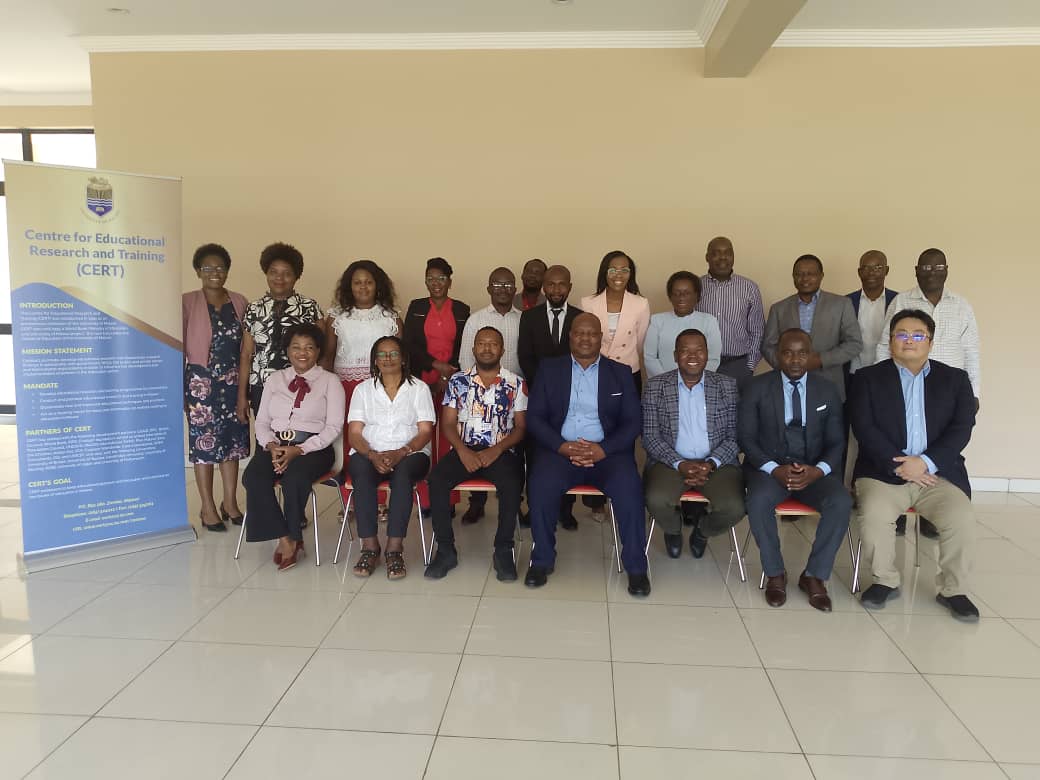
Through the Unlocking Data Initiative, a consortium of Pan-African partners (eBASE Africa, EdTech Hub, ESSA, the University of Malawi’s Centre for Educational Research and Training (CERT), and Zizi Afrique Foundation) are at the forefront of efforts to answer these questions. This initiative (active in Cameroon, Kenya, and Malawi) aims to ensure that data becomes a powerful tool for educational transformation. 

To engage with partners and actors in the space, the Unlocking Data Initiative hosted a webinar on August 21, 2024, to launch the new phase of activities as part of the KIX grant. A wide range of organisations and participants including, representatives from the Ministries of Education in Cameroon, ⁠Mr TohMoh Joseph (Technical Advisor), Kenya, Mr Bartholomew Lumbasi (Director of Policy), and Malawi, ⁠Mr. Lanken Nkhata (Ag Head EMIS). These representatives joined researchers and education advocates through this interactive session to discuss data democratisation and explore ways of increasing access to and uses of education data. 

The Barriers to Unlocking Data

While the potential of open data is immense, early findings from the Unlocking Data Initiative research activities resonate with the experiences of stakeholders and partners. Simply put, significant challenges remain:

  1. Accessibility and Transparency: Many public datasets are difficult to access or not openly available, and the processes for requesting data can be opaque and bureaucratic. This includes a lack of clear metadata, original documentation, and contextual information to support the interpretation and appropriate use of the data. 
  2. Interoperability and Standardization: Data across different government agencies and programs often use different terminologies, formats, and definitions, making it difficult to aggregate and analyse data holistically. 
  3. Data Quality and Reliability: The quality of data collected is another critical issue. Inconsistent methods, outdated information, and political interference often undermine the reliability of evidence. For African nations to tell their stories and address challenges like learning poverty effectively, they need authentic, high-quality data that reflects their realities.
  4. Ethical Dilemmas in Data Sharing: Balancing transparency with confidentiality is a constant challenge. CSOs working with vulnerable populations must navigate ethical considerations, especially when data contains sensitive information about learners. Without proper anonymization and responsible use protocols, the risks of harm increase.
  5. Collaboration and Trust: Perhaps the biggest hurdle is the lack of collaboration between stakeholders. Mistrust, competing priorities, and unclear frameworks for data sharing create barriers that limit progress. For instance, while initiatives like Education Evidence for Action (EE4A) have made strides in fostering partnerships, much more needs to be done to bridge gaps and build trust.

A Path Forward

The Unlocking Data Initiative offers a promising model for change. By mapping foundational learning ecosystems, identifying gaps, and building capacity, this initiative is laying the groundwork for stronger, more collaborative data ecosystems.

Key strategies for success include:

  • Co-creation: Bringing together governments, CSOs, researchers, academics, and private organisations to design data tools and processes that are inclusive and responsive to local needs.
  • Digital Innovation: Establishing digital evidence hubs, such as the one proposed for Kenya’s Ministry of Education, to improve access and streamline data sharing.
  • Trust-Building: Developing clear policy frameworks and agreements to guide data sharing and ensure mutual accountability.
  • Capacity Building: identifying and plugging capacity gaps, especially with state actors and researchers, to not only be able to share data but also increase its usage in their decision-making.

By addressing these challenges head-on, Africa’s education sector can harness the full potential of open data to improve learning outcomes, reduce inequities, and drive sustainable change.

Unlocking data isn’t just about technology or policy—it’s about collaboration, trust, and a shared commitment to the future of Africa’s learners. As the Unlocking Data Initiative and other efforts gain momentum, it provides a blueprint for how data can transform education systems and, ultimately, lives.

The question is no longer whether open data can make a difference but how we can overcome the barriers to make it a reality. Let’s continue the conversation—and the work—of Unlocking Data for a brighter future. Please visit our website and follow our partners CERT. eBASE, EdTech Hub, ESSA, and Zizi Afrique Foundation on social media. You are also invited to participate and contribute to this work by joining our community of practice and Unlock the potential of Data!